
Communication Accidents – Part 2: Operation Room “Why Isn’t the Surgical Power Tool Drilling?”
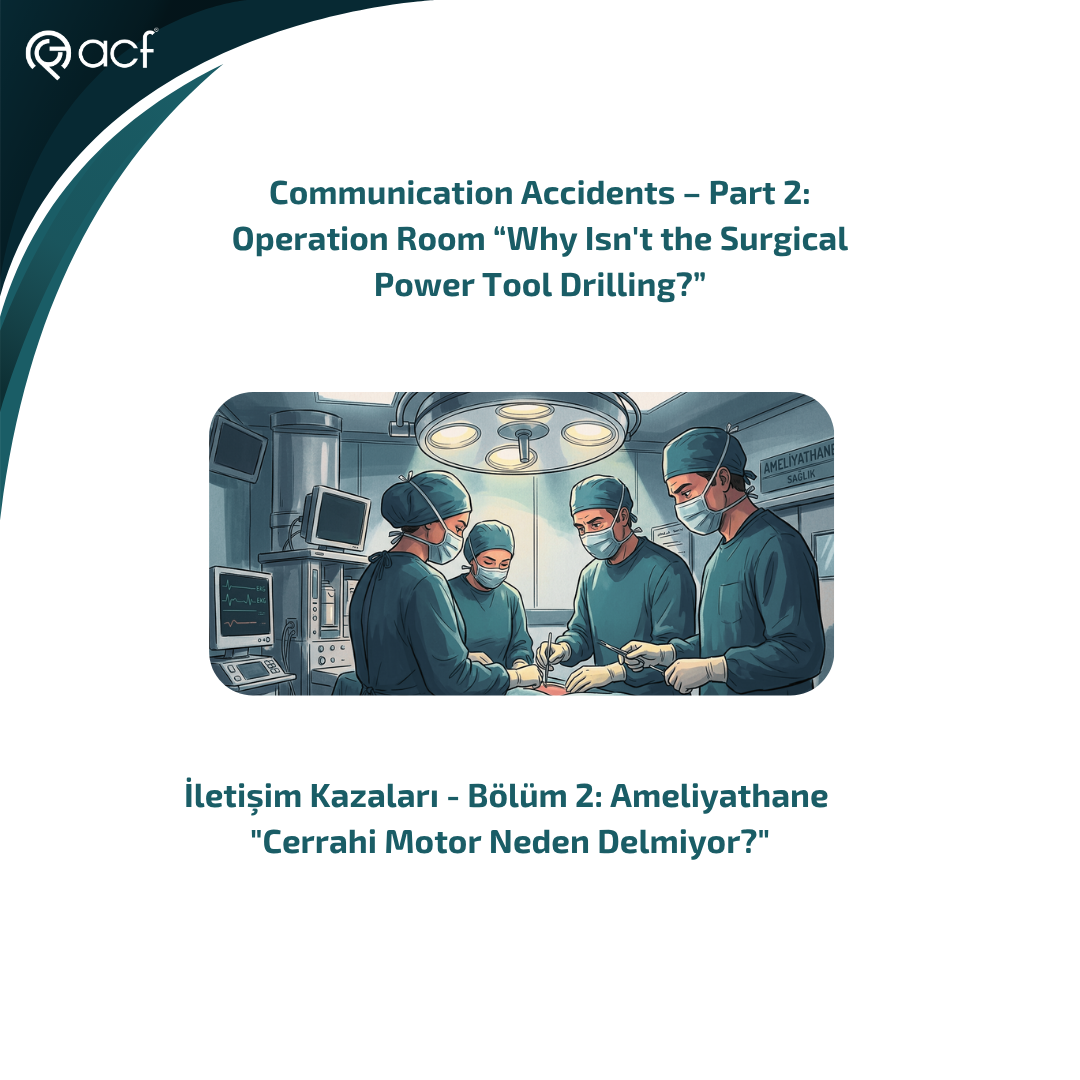
07 April, 2026
The Right Attachment, Clear Communication: Small Touches That Change the Fate of Surgery.
The word “surgery” (ameliyat) originally means simply “the work performed.” Just like a surgical power tool, it is a system on its own—but in the right hands and with the right communication, it transforms into a life-saving intervention.
The operating room is not defined by a single device, but by a system where dozens of different components work in harmony. This system consists of the surgeon, the assisting team, nurses, the anesthesiologist, sterilization processes, imaging systems, surgical instruments, and of course, critical equipment like the surgical power tool and surgical power tool attachments. Each part is meaningful on its own, but the true value emerges when these parts function together correctly. In the OR, no tool is sufficient by itself; a surgical power tool gains meaning through the correct attachment, and every piece of equipment, every person, and every process is an indispensable part of this larger system.
The word “surgeon” (cerrah) derives from the Arabic root cerh, meaning “to cut, to open, to intervene.” In this sense, a surgeon is not just someone who cuts, but someone who restores order through intervention. Within the operating room, this role naturally positions them as the manager of the system. The surgeon manages not only the operation but also the team, the workflow, and the moments of decision. What they intervene in is not just tissue, but the system itself.
Sometimes, this system breaks at its simplest point, even when it is at its strongest. In one instance, a surgeon attempting to drill with a surgical power tool and its connected attachment fails to get the expected performance and naturally reacts: “Why isn’t this drilling?” In that moment, the atmosphere tenses, voices rise, and focus scatters. Yet, the problem lies neither with the surgical power tool nor the power of the system. The attachment in the surgeon’s hand is actually a reamer; the system is being forced to perform a task it wasn’t designed for. Everyone in the team actually sees this, but due to the pressure of the moment, they either fail to realize it or cannot voice it. No one can utter that simple sentence: “The attachment in your hand is a reamer.” In such moments, technical knowledge retreats, communication falls silent, and the system locks itself down.
However, that same moment could be managed differently. If the surgeon could express their need clearly and constructively—saying, “I’m not getting enough speed; are we sure we’re using the right attachment?”—the team would immediately bring the correct attachment, the surgical power tool would function with the right configuration, and the process would return to its flow. Most of the time, the problem is not with the device, but with the failure to communicate the need accurately.
In reality, the surgeon’s focus is very clear: to restore the integrity of the patient’s body who has trusted them and to achieve the expected healthy outcome. Every delayed second amplifies the anxiety of failing to keep that promise. Therefore, they don’t want to be alone; they want that burden to be shared. The fundamental responsibility of the team is not to be crushed under the surgeon’s stress, but to shoulder that weight. Sometimes a raised voice is not an act of pressure, but a cry to be heard. When this cry is not met with the right response, the hands extended to help are withdrawn, and the system struggles even further.
At this exact point, communication becomes the invisible surgical power tool of the operating room. Just as a surgical power tool gains purpose through the right attachment, the right speed, and correct usage, communication drives the system when established at the right time, by the right person, and in the right way. Just as a surgical power tool becomes inefficient with the wrong attachment, communication loses its impact when silenced at the wrong time or delivered in the wrong tone. Yet, a single courageous and correct sentence is like identifying the wrong surgical power tool attachment and restarting the system with the correct one; it fixes the entire flow with one small touch.
And in that moment, it is realized: In the operating room, communication is a system just as much as the surgical power tool is. When it works correctly, it saves lives; when it falls silent, it can halt even the most powerful system.