
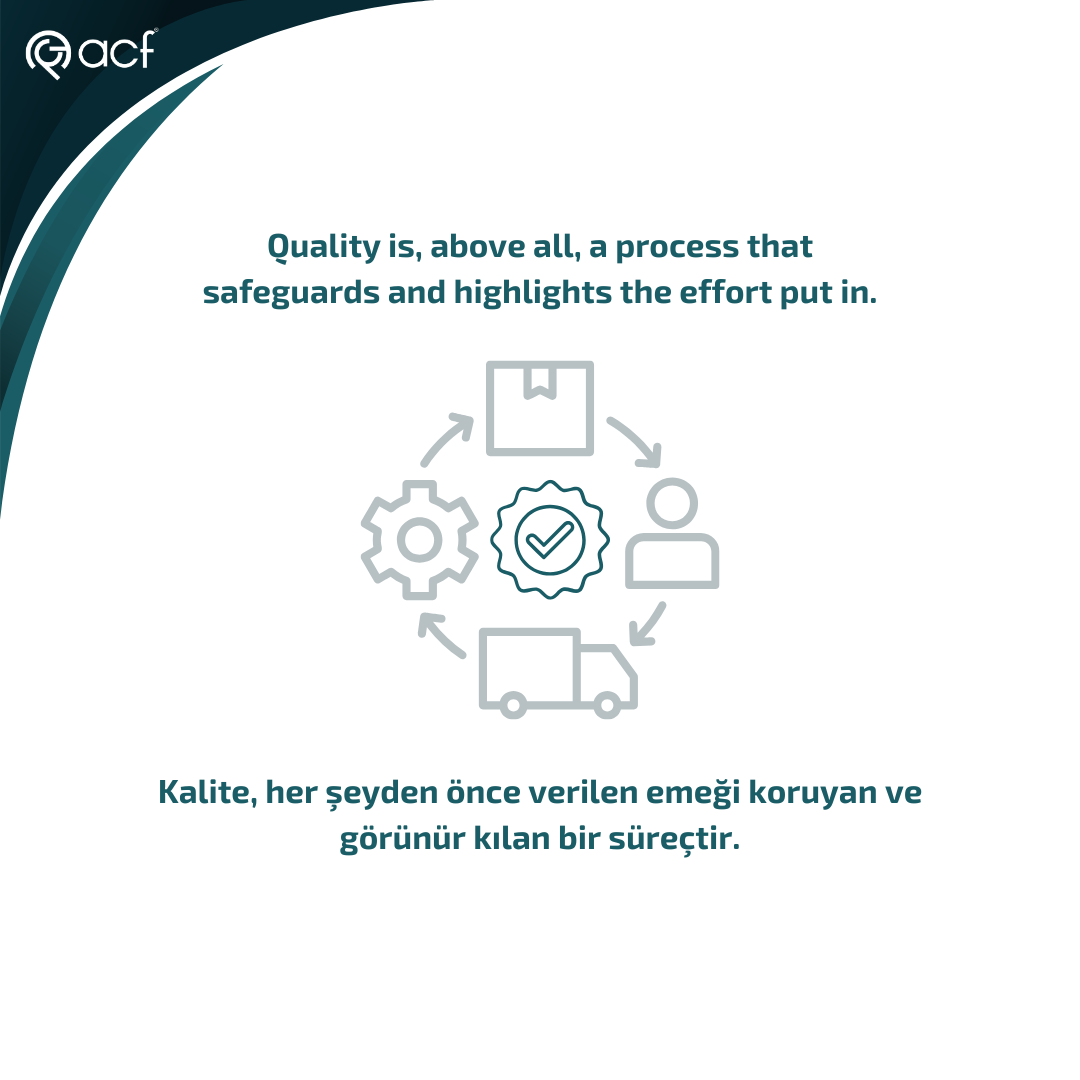
Quality Is, Above All, a Process That Protects and Makes Effort Visible
October 12, 2026
True quality is built not only in the final product, but at every step of the process.
A product is often evaluated at the final stage as either good or bad. Does it work? Does it fulfill its function? Does it deliver the expected performance? At first glance, these questions may seem sufficient. However, for those who truly understand manufacturing, the real evaluation neither begins nor ends here. Because the final outcome is merely a reflection of the process behind it.
In production lines where sensitive products such as surgical motors and surgical saws are manufactured, evaluating quality solely based on the final result makes a significant amount of effort invisible. A product may pass final inspection and perform its function. However, the guarantee that this performance can be repeated with the same level of reliability every time can only be ensured through the process itself. If the process is not controlled, the outcome may not always be consistent. And even if this is not immediately visible from the outside, it introduces uncertainty within the system.
For manufacturers who truly understand their production lines and test quality repeatedly at different stages, the concept of “error” is also different. Most of the time, an error is not a defect but a signal. It may indicate missing information, a misinterpreted step, or an undefined process. When approached from this perspective, errors are no longer something to hide, but opportunities to learn. Because every properly analyzed deviation strengthens the process.
This is where the value of investing in quality becomes evident. Measurements performed, validations conducted, records maintained, and repeated controls… Each of these elements builds process reliability. Although these activities may initially appear to require time and resources, they are in fact the most powerful tools for eliminating uncertainty in the long run. As the process becomes clearer, the outcome becomes more predictable.
One of the most important effects of this approach is the value it places on people. A company that manages quality as a process protects not only the product, but also the effort of everyone involved in creating it. From designers to production line operators, from quality control specialists to the logistics team, every contribution gains meaning within this system. The quality management process makes effort visible and transforms it into sustainable value.
Ultimately, quality is not merely an output to be evaluated once the product is completed. Quality is the system that ensures the same result can be achieved consistently every time. Those who invest in this system do not only produce good products — they build trust. And that trust, sooner or later, always finds the recognition it deserves.