
The Direction of Mastery: Modular Handpiece and Surgical Power Tool Calibration in Arthroplasty Operations
September 20, 2026
The high-stress atmosphere of the operating room maximizes the dynamism of the surgical team, yet it can sometimes cause the most fundamental technical details to fade into the background. Surgical power tool systems are not merely mechanical instruments; they are an extension of the surgeon’s hand, operating with micro-millimetric precision. However, even the most masterful hands can overlook directional perception or mechanical configuration during surgery. Technical accuracy is the most loyal and unforgiving companion of surgical mastery.
A Mechanical Paradox: The Anatomy of Reverse Rotation
Imagine turning a car’s tires completely to the right while insistently trying to push the vehicle to the left. In this scenario, not only do the tires wear down with extraordinary friction, but the vehicle’s potential speed drops dramatically, the engine reaches a stalling point, and most importantly, the surface it contacts is permanently damaged. During an arthroplasty operation, setting the surgical power tool handpiece used by the surgeon to the reverse direction creates precisely this mechanical paradox.
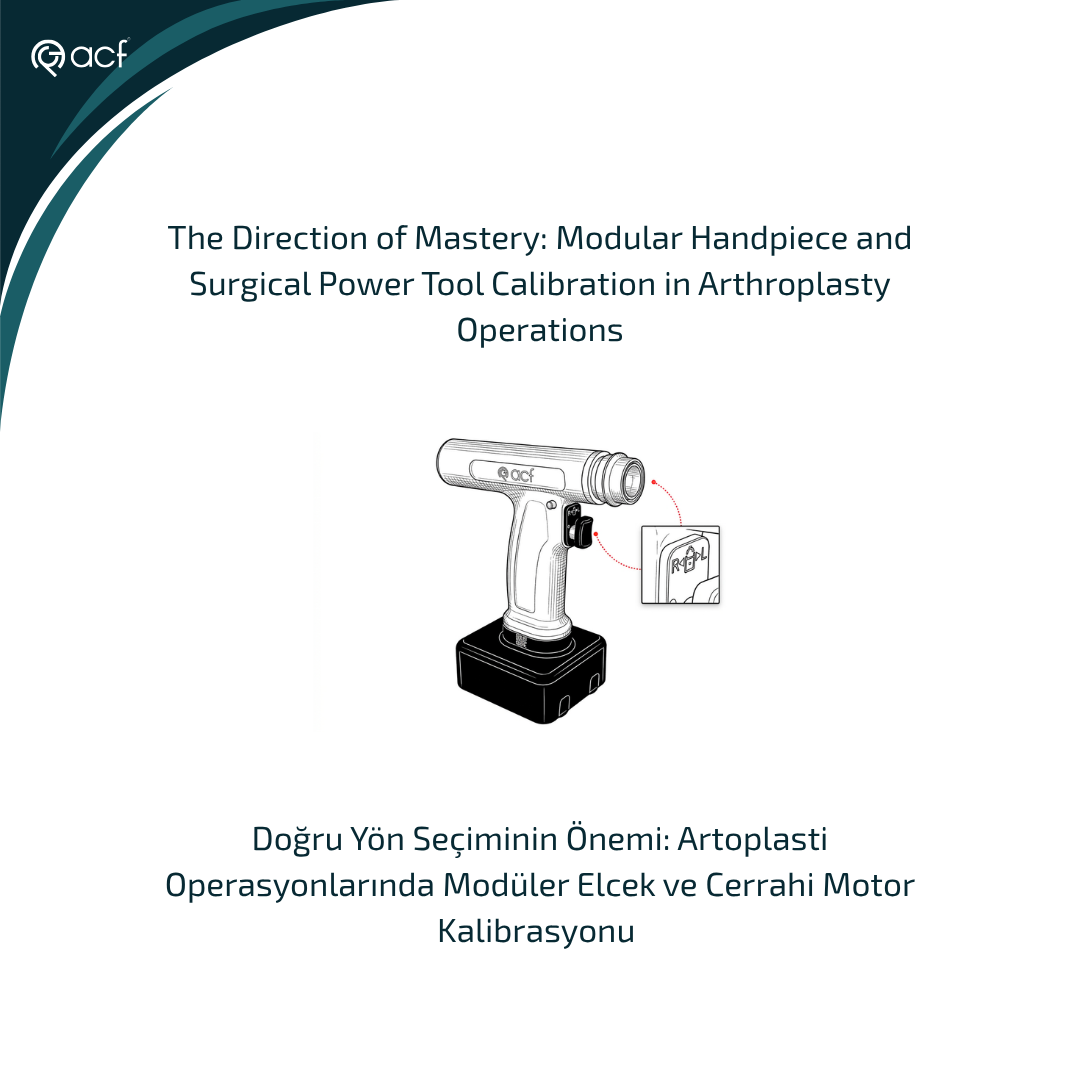
Investigations conducted on modular handpiece failures reaching technical services frequently reveal rotational strains resulting from user error. Especially in hip replacements, the acetabular reamer and high-torque reamer systems are designed according to a specific cutting direction (Clockwise – CW). Unintentionally setting an instrument, whose grating direction is optimized to the right, to the left (Counter-Clockwise – CCW) completely eliminates the primary function of the system.
A situation during surgery where the device performance falls short of expectations or the cutting speed feels slow stems from the current directional mismatch between the geometric working orientation of the instrument and the motor torque, rather than an insufficiency in motor power. To preserve the surgeon’s operative comfort and facilitate their work, performing a quick directional check before concluding a structural deficiency regarding the surgical power tool is the most practical way to rapidly optimize the process.
Clinical Challenges and Tissue Risks
An orthopedic specialist’s command over the operative field is directly related to the patient’s anatomical structure. Especially in hip replacements of obese patients with a high body mass index, when the patient is positioned in the lateral decubitus position (side-lying), dense soft tissue and adipose layers can severely restrict the surgical field of view. This makes it difficult for the orthopedic surgeon to visually verify the clear rotation direction of the reamer head on the bone tissue. However, no matter how limited the visibility, the choice of direction remains a vital parameter.
An acetabular reamer operating with a surgical power tool spinning in the reverse direction rubs against the tissue instead of reaming the bone. This leads to an increase in the friction coefficient, thereby causing a risk of uncontrolled thermal necrosis in the surgical field. Excessive overheating in bone tissue triggers the loss of osteocytes, undermining the success of implant anchoring to the bone (osseointegration). Mechanically, the reverse loading can expose the internal gear mechanisms of the modular handpiece to micro-fractures.
Rotation Direction and Torque Management for Optimum Performance
Achieving a flawless implant bed in arthroplasty operations depends heavily on repetitive drilling speed control and instrument compatibility. The cutting blades on acetabular reamer systems, especially those used in hip replacements, are geometrically designed exclusively to ream in the rightward direction (Clockwise – CW) and to evacuate the resulting bone debris inward from the sphere. When encountering a slowdown in cutting speed or a lack of reamer progression in the bone during surgery, checking the rotation direction before jumping to a premature conclusion about the device’s technical capacity will make your work significantly easier.
Because when the motor torque direction and the cutting direction of the instrument are not synchronized, the penetration (progression) speed can approach zero even if the device operates at maximum torque power; this, in turn, can lead to undesirable friction heat in the bone. To keep your operating room workflow and surgical comfort uninterrupted, verifying the device direction with a small mechanical confirmation step together with your assistant staff will ensure you always get that high and smooth performance you desire from drilling and reaming systems.
Accordingly, the meticulous preliminary preparations by operating room personnel and auxiliary healthcare teams provide an invaluable foundation for the seamless progression of the surgical workflow. In addition to this valuable preparation process, the surgeon directly managing the instrument performing a brief visual or mechanical check on the device’s rotation direction right before starting the operation is a practical, workflow-facilitating step that safeguards surgical comfort and flow. It must be remembered that technical synchronization is the most harmonious and supportive companion of surgical mastery in the operating room.