
GS1 and UDI in Medical Devices: The Foundation of Product Traceability
September 20, 2026
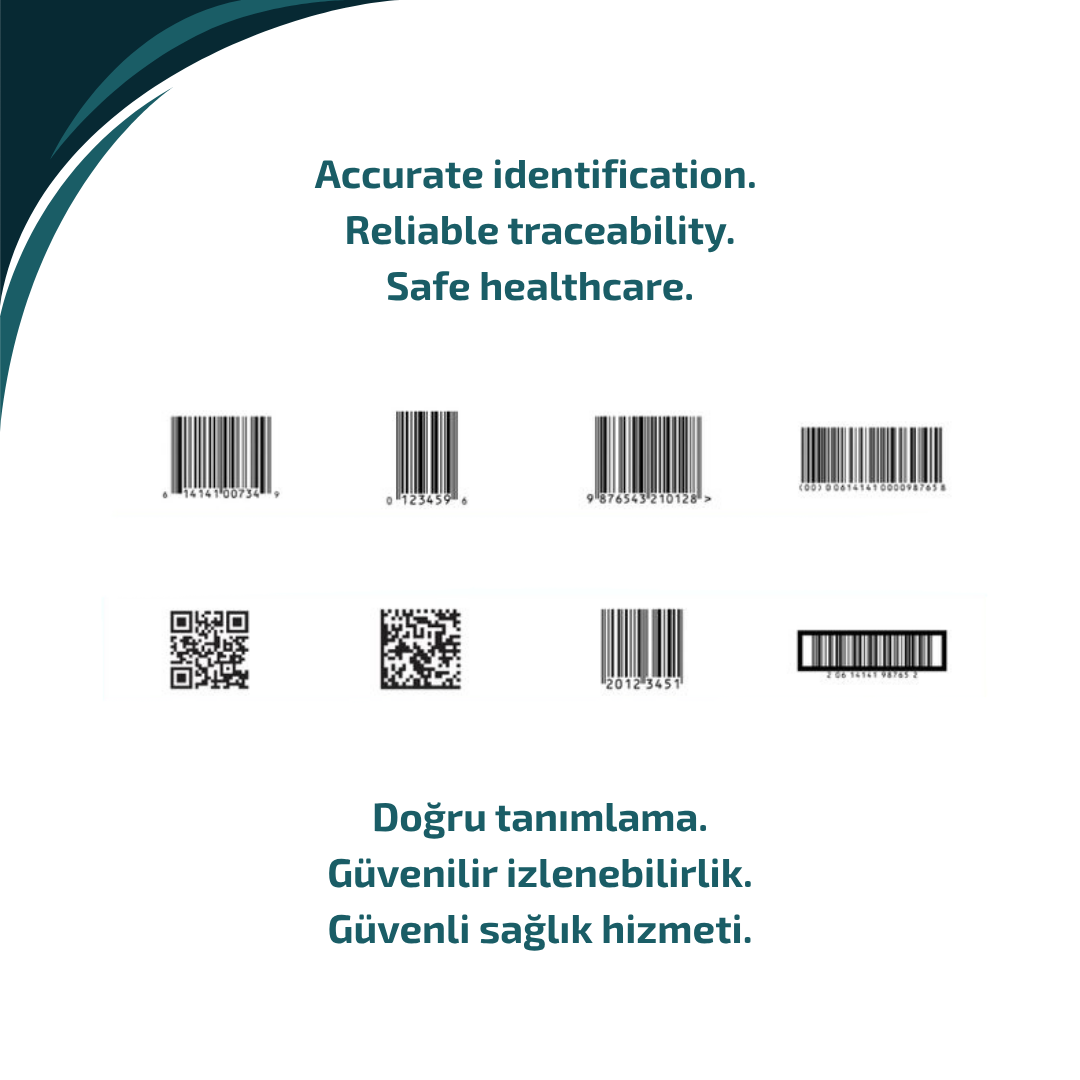
Today, manufacturing a product is no longer enough. It is equally important to identify products correctly, ensure their traceability, and manage reliable information throughout their entire lifecycle.
Especially in the medical device industry, information such as the manufacturer, product model, production date, batch or serial number plays a critical role in ensuring patient safety and regulatory compliance.
At this point, GS1 standards and the Unique Device Identification (UDI) system serve as one of the fundamental building blocks of medical device traceability.
What is GS1?
GS1 (Global Standards 1) is a global standards organization that enables products and business information to be identified consistently worldwide.
Simply put, GS1 provides products with a globally recognized identity.
From the moment a product is manufactured, it must be accurately identified and tracked throughout its journey—from the manufacturer to suppliers, warehouses, healthcare institutions, and ultimately the end user. GS1 standards enable product information to be shared using a common language across different countries and systems.
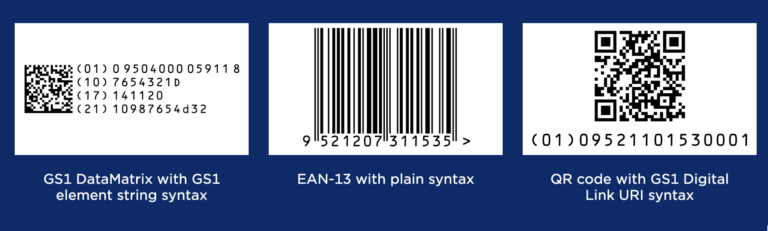
GS1 is much more than just barcodes. It encompasses a comprehensive set of standards designed to support product identification, data sharing, and traceability.
The main GS1 standards include:
- GTIN (Global Trade Item Number): A globally unique number used to identify trade items.
- GLN (Global Location Number): Identifies companies, facilities, and physical locations.
- DataMatrix: A two-dimensional barcode capable of storing a large amount of data in a small space, widely used in the healthcare industry.
- SSCC (Serial Shipping Container Code): A numbering system used to identify and track logistics units such as cartons and pallets.
What is GTIN?
GTIN (Global Trade Item Number) is the unique number that identifies a product worldwide.
You can think of a GTIN as a product’s identity number.
Just as every person has a unique identification number, every product has its own GTIN that distinguishes it from all others.
When a barcode is scanned, the GTIN serves as the primary identifier that allows the system to retrieve the correct product information.
Information associated with a GTIN may include:
- Product name
- Manufacturer information
- Product reference
- Product classification
- Packaging information
GTIN is available in different formats:
- GTIN-8: An 8-digit format used for small-sized products
- GTIN-12: Commonly used in North America
- GTIN-13: The most widely used product identification format worldwide
- GTIN-14: Primarily used for cartons and higher packaging levels
What is EAN-13 / GTIN-13?
EAN-13 (GTIN-13) is a 13-digit GS1 numbering format used to uniquely identify products worldwide.
Most barcodes found in supermarkets, pharmacies, and retail products use the EAN-13 format.
EAN-13 is simply the barcode representation of a product’s GTIN, allowing barcode scanners to retrieve the associated product information.
A GTIN-13 may be linked to information such as:
- Manufacturer
- Product reference
- Product description
- Commercial information
EAN-13 is widely used to identify products at the individual retail unit level. As part of the GS1 standards, it enables products to be recognized consistently across countries and information systems, creating a common language for global trade.
What Is the Difference Between a Barcode and a GTIN?
Although the terms barcode and GTIN are often used interchangeably, they refer to different concepts.
A GTIN is the product’s unique identifier.
A barcode is the machine-readable representation of that identifier.
In other words, the GTIN represents the data, while the barcode enables that data to be captured quickly and accurately.
The Relationship Between GS1 and UDI in Medical Devices
To ensure traceability throughout the lifecycle of medical devices, the Unique Device Identification (UDI) system is used.
The UDI system enables each medical device to be uniquely identified while providing access to critical production information.
A UDI consists of two main components:
UDI-DI (Device Identifier)
The Device Identifier (UDI-DI) is the fixed portion of the UDI that identifies the device itself.
Examples include:
- Product model
- Product type
- Manufacturer information
These attributes remain unchanged.
UDI-PI (Production Identifier)
The Production Identifier (UDI-PI) contains variable production-related information.
Examples include:
- Lot number
- Serial number
- Manufacturing date
- Expiration date
What is GS1 DataMatrix?
GS1 DataMatrix is a two-dimensional barcode capable of storing a large amount of data within a very small area.
It is widely preferred in the medical device industry because it allows product identity and production-related information to be encoded in a compact, reliable, and internationally standardized format.
The information contained within a GS1 DataMatrix enables products to be reliably tracked throughout:
- Manufacturing
- Quality control
- Shipping and distribution
- Technical service
- Product recalls and post-market traceability
What Do the Numbers in a GS1 DataMatrix Mean?
The numbers enclosed in parentheses within a GS1 DataMatrix are called Application Identifiers (AIs).
These identifiers indicate the type of information encoded in the barcode.
AI Code | Description |
(01) | GTIN / UDI-DI – Unique product identifier |
(10) | Lot Number |
(11) | Manufacturing Date |
(17) | Expiration Date |
(21) | Serial Number |
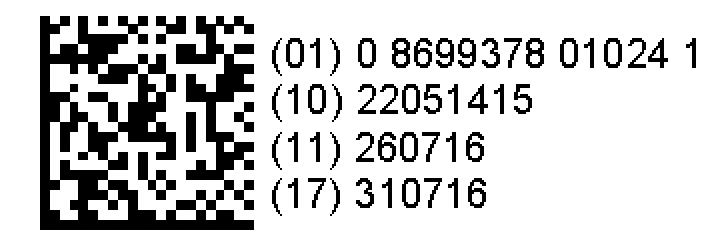
According to the example above:
- (01): GTIN (UDI-DI): 08699378010241
- (10): Lot Number: 22051414
- (11): Manufacturing Date: 16.07.2025
- (17): Expiration Date: 31.07.2031
This standardized structure ensures that any GS1-compliant system interprets the encoded information consistently. As a result, manufacturers, distributors, healthcare providers, and regulatory authorities all use the same data language.
GS1 DataMatrix and UDI Implementation in ACF Medical Products
To ensure accurate identification and traceability throughout the entire product lifecycle, ACF Medical uses GS1 DataMatrix technology across its medical device portfolio.
GS1 DataMatrix is a two-dimensional barcode that securely stores a product’s unique identity together with critical production-related information within a compact space.
Depending on the product type and regulatory requirements, ACF Medical’s GS1 DataMatrix codes contain the necessary traceability information within both the UDI-DI and UDI-PI components.
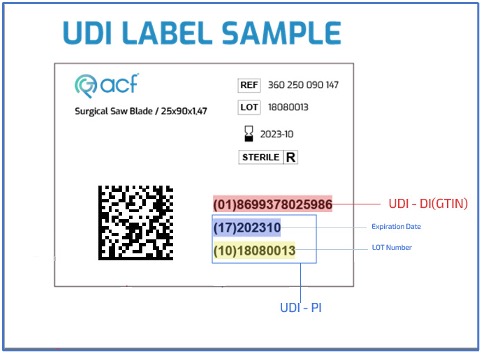
This enables accurate product tracking throughout manufacturing, quality control, shipping, and technical service processes.
By implementing GS1 DataMatrix, ACF Medical not only ensures proper product identification but also supports a reliable, transparent, and sustainable traceability system throughout the product lifecycle.
Benefits of Using GS1
Implementing GS1 standards offers numerous advantages:
✅ Ensures accurate product identification
✅ Reduces errors throughout the supply chain
✅ Improves product traceability
✅ Simplifies digital data management
✅ Establishes a common language for international trade
✅ Contributes to patient safety in the medical device industry
Conclusion
A product’s reliability is determined not only by its manufacturing quality but also by how accurately it can be identified and traced throughout its lifecycle.
GS1 standards and the UDI system establish a robust traceability framework by ensuring reliable information flow between manufacturers, healthcare institutions, distributors, regulatory authorities, and end users.
At ACF Medical, we implement GS1 DataMatrix and UDI requirements as an integral part of our product lifecycle management to ensure our medical devices are identified, tracked, and managed in accordance with international standards while supporting safe and reliable use.